
What Should Shippers Do When Freight Arrives Damaged?
Quick Answer
When freight arrives damaged, shippers should document the condition immediately, note visible damage on the delivery receipt, notify the appropriate parties, and preserve the shipment and packaging whenever possible. They should also review the applicable transportation agreement and claim requirements before submitting a formal freight claim.
The first priority is to establish what happened and preserve the evidence needed to investigate it.
Waiting too long, discarding damaged packaging, or signing a clean delivery receipt without recording visible damage can make a claim more difficult to support.
For businesses shipping valuable, fragile, or time-sensitive products, damage handling should be part of the transportation process—not an afterthought once the delivery is complete.
1. Inspect the Shipment Before Accepting Delivery
When a truck arrives, receiving teams are often focused on unloading quickly and moving freight into inventory.
That pressure can make it tempting to sign the delivery paperwork and inspect the shipment later.
However, the condition of the freight should be checked as early as practical.
Look for signs such as:
- Crushed, torn, or punctured cartons
- Broken pallets or shifted freight
- Wet packaging or signs of exposure
- Damaged shrink wrap or broken seals
- Visible product damage
- Packaging that appears to have been opened or mishandled
If damage is visible, record it on the delivery receipt or proof of delivery before signing, using specific descriptions rather than vague comments.
For example, “two cartons crushed on the lower right side of pallet” provides more useful information than simply writing “damaged.”
If the damage is not immediately visible, follow the applicable concealed-damage reporting procedures and notify the relevant parties promptly.
2. Photograph the Damage and Preserve the Evidence
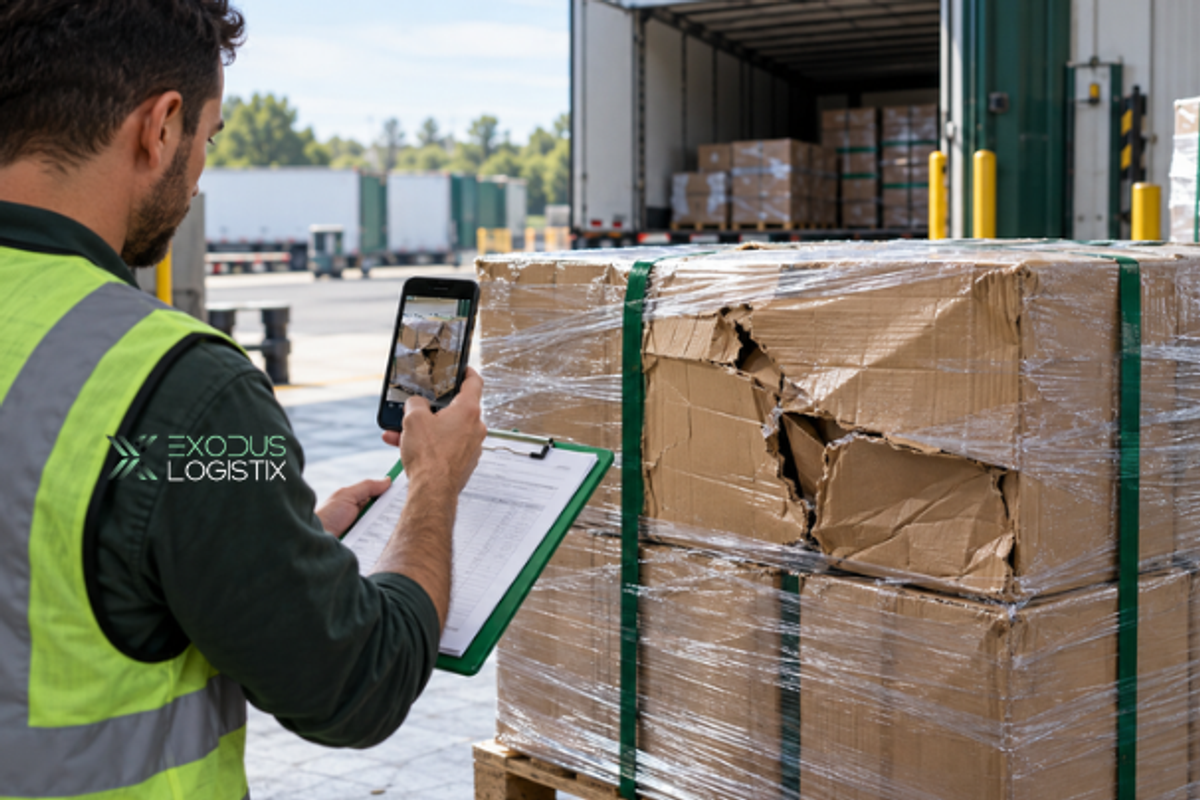
Photographs help establish the condition of the shipment at the time it was received.
Take clear pictures of:
- The full shipment and pallet configuration
- Damaged cartons or containers
- Individual damaged products
- Shipping labels and identifying numbers
- The trailer or load condition, when relevant and permitted
- Packaging materials and protective supports
Capture both wide shots and close-ups. A close-up may show a puncture, while a wider image can help explain where that damage occurred within the shipment.
Do not discard damaged packaging or rearrange the shipment more than necessary before documenting its condition. Keep affected items and materials available for inspection when possible.
If safety, contamination, or other operational requirements make immediate handling necessary, prioritize safety and document the condition before moving items whenever practical.
The objective is to preserve a clear record—not to assume who caused the damage before the facts are established.
3. Notify the Right Parties Promptly
Once damage is identified, notify the appropriate contacts. Depending on the shipment, this may include the carrier, freight broker or logistics provider, shipper, supplier, consignee, insurer, or claims representative.
Provide the shipment reference, delivery date, description of the damage, photographs, and any notes recorded at delivery.
Keep a record of when the issue was reported and to whom.
Prompt communication matters because different parties may need to arrange an inspection, review transportation records, or determine how the damaged goods should be handled.
Do not assume that reporting damage automatically constitutes a formal freight claim. A notification, an inspection request, and a formal claim may be separate steps with different requirements.
Review the applicable contract, carrier rules, and claim procedures to determine what must be submitted and by when.
4. Determine the Extent of the Damage Before Deciding What Happens Next
Visible packaging damage does not always mean the product is unusable. Likewise, packaging that looks intact does not guarantee that the contents are undamaged.
The receiving team should work with the appropriate internal and external contacts to establish the extent of the loss.
Questions to resolve include:
- How many units or cartons are affected?
- Is the product safe to handle and use?
- Can the goods be repaired, repackaged, or sold at a reduced value?
- Is replacement necessary?
- Does the damage affect only part of the shipment or the entire load?
- Is an inspection required before the product is moved, repaired, or disposed of?
Avoid discarding, repairing, returning, or disposing of damaged goods before checking whether an inspection or other evidence-preservation step is required.
The appropriate response depends on the product, the severity of the damage, safety requirements, and the terms governing the shipment.
5. Assemble the Documentation for a Freight Claim
A well-supported claim gives the reviewer a clear account of the shipment, the damage, and the amount being claimed.
Depending on the circumstances and the applicable claim requirements, relevant records may include:
Document or record
Why it matters
Bill of lading
Identifies the shipment and transportation details
Proof of delivery
Records delivery and any damage notations
Photographs
Show the condition of the goods and packaging
Commercial invoice
Helps establish the goods' value
Packing list
Identifies the products and quantities shipped
Inspection or damage report
Describes the condition and extent of the damage
Repair or replacement estimate
Supports the amount of the claimed loss
Shipment and delivery records
Help establish the timeline
Correspondence
Records notifications, responses, and follow-up
Not every claim requires every document listed above. Requirements vary by shipment, carrier, contract, and governing rules.
The claim should clearly identify the shipment, explain what was damaged, state the amount being claimed, and include the supporting documentation required by the applicable process.
Keep copies of all submitted records and follow up through a documented communication trail.
6. Investigate the Cause Instead of Stopping at the Claim
A claim may address the financial consequences of damaged freight. It does not necessarily explain why the damage happened.
To reduce repeat incidents, businesses should review the circumstances surrounding the shipment.
Possible contributing factors include:
- Insufficient packaging or load securement
- Improper palletization
- Freight shifting during transit
- Incompatible products loaded together
- Handling during transfers between facilities
- Exposure to moisture or unsuitable conditions
- Equipment or loading practices that did not match the shipment's requirements
These are possibilities to investigate, not conclusions to assume.
Review available photographs, loading records, packaging specifications, handling instructions, inspection findings, and transportation records. Look for patterns across similar shipments, products, routes, facilities, or handling methods.
If the same product repeatedly arrives damaged, the issue may require changes to packaging, loading procedures, equipment selection, handling instructions, or transportation planning.
The goal is to identify a cause that can be addressed—not simply to process another claim.
7. Make Damage Prevention Part of Transportation Planning
Freight damage prevention begins before a shipment leaves the facility.
The appropriate controls depend on the product and its handling requirements, but shippers can review several areas:
Packaging and palletization: Confirm that packaging is suitable for the product, shipment conditions, and expected handling.
Load securement: Make sure freight is properly positioned and secured to reduce unnecessary movement during transit.
Equipment selection: Match the transportation equipment to the shipment's dimensions, weight, handling needs, and any special requirements.
Handling instructions: Communicate specific requirements clearly to the parties responsible for loading, transporting, and receiving the goods.
Carrier and route considerations: Review handling requirements, transfer points, and other transportation factors that may affect the shipment.
Performance tracking: Record damage incidents by product, facility, lane, carrier, and shipment type where the data is available and reliable.
Tracking these details helps businesses distinguish isolated incidents from recurring problems that warrant corrective action.
No transportation plan can eliminate every risk. However, clear requirements, appropriate equipment, careful handling, and consistent communication can help reduce avoidable exposure.
8. Measure More Than the Number of Claims
A lower number of claims may appear to indicate improvement, but claim counts alone do not tell the full story.
A business shipping fewer loads could see fewer claims without improving its damage rate. A small number of incidents involving high-value products could also create more financial impact than several minor claims.
A more useful review may include:
- Damage incidents relative to shipment volume
- Financial value of damaged goods
- Damage frequency by product or facility
- Repeated damage patterns by shipment type or route
- Time required to investigate and resolve claims
- Corrective actions completed after an incident
Use consistent definitions and reliable records when comparing results over time.
These measures can help transportation and operations teams determine whether prevention efforts are working and where additional investigation may be needed.
What This Means for Shippers
When freight arrives damaged, the immediate response matters. So does what happens afterward.
A clear process helps receiving teams document the condition, preserve evidence, notify the right parties, and assemble the necessary records. A structured review can then help the business understand whether the incident points to a broader problem with packaging, handling, equipment, or transportation coordination.
At Exodus Logistix, transportation management involves more than arranging a truck. Shipment requirements, communication, equipment considerations, and coordination all play a role in moving freight according to the needs of the operation.
For businesses dealing with recurring damage or complex freight requirements, reviewing how shipments are prepared and managed can help identify opportunities to improve handling and reduce avoidable risk.
Frequently Asked Questions
What should I do first when freight arrives damaged?
Inspect the shipment, document visible damage on the delivery paperwork, take photographs, and notify the appropriate parties promptly. Follow the applicable procedures for concealed damage if the issue is discovered after delivery.
Should I sign the proof of delivery if the shipment is damaged?
If damage is visible, record it clearly on the delivery receipt before signing, following the receiving process and applicable instructions. Avoid signing a clean receipt that fails to reflect known visible damage. If the damage is concealed, follow the applicable reporting procedure.
How long do I have to file a freight damage claim?
The deadline depends on the applicable law, transportation agreement, carrier rules, and type of shipment. Review the governing requirements promptly rather than assuming a standard deadline applies to every shipment.
What documents are needed for a freight damage claim?
Common supporting records include the bill of lading, proof of delivery, photographs, commercial invoice, packing list, damage report, and documentation supporting the claimed amount. The exact requirements vary, so confirm them with the relevant carrier or claims representative.
Can a shipper file a claim if the damage is discovered after delivery?
A claim may still be possible, but concealed damage can be more difficult to investigate. Document the condition as soon as it is discovered, preserve packaging where possible, notify the relevant parties, and follow the applicable reporting and claim requirements.
How can businesses reduce freight damage?
Businesses can review packaging, palletization, load securement, equipment selection, handling instructions, and transportation procedures. Tracking incidents and investigating recurring patterns can help identify which corrective actions are most appropriate.
Final Thoughts
Damaged freight creates more than a claims problem. It can affect inventory availability, customer commitments, replacement costs, and the time employees spend investigating what happened.
The most effective response combines immediate documentation with a careful review of the cause.
Record the damage. Preserve the evidence. Follow the applicable claim process. Then use the available information to determine what can be improved before the next shipment moves.
Because resolving a damaged shipment is important—but preventing the next one is better.
Review your freight requirements and transportation process with Exodus Logistix: https://exoduslogistix.com/
Tags

About the Author
exodus logistix
Exodus Logistix provides freight and logistics solutions built on disciplined planning, clear coordination, and operational accountability. With experience supporting complex shipments across multiple industries, the team focuses on reducing disruption, improving reliability, and helping businesses move freight with confidence.