
How Should Shippers Audit Freight Invoices Before Approving Payment?
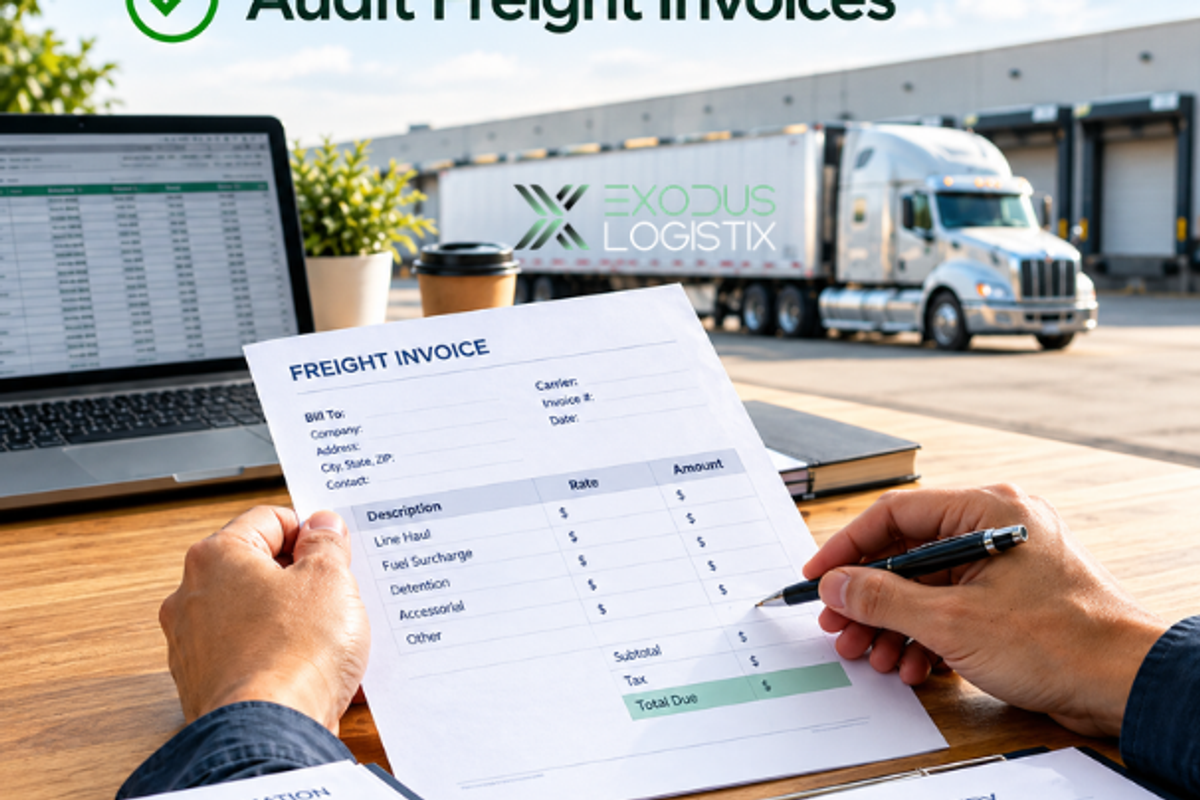
Quick Answer
Shippers should audit freight invoices by comparing each charge against the agreed rate, shipment documentation, delivery records, and any approved additional services.
A consistent freight invoice audit process helps businesses identify duplicate billing, incorrect rates, unsupported accessorial charges, and discrepancies between the services ordered and the services billed.
The most effective approach is to verify charges before payment, document exceptions, and track recurring discrepancies to improve transportation cost control over time.
Why Freight Invoice Auditing Matters
A freight invoice represents more than the cost of moving a shipment. It reflects the transportation services performed, the agreed pricing, and any additional charges associated with that movement.
When invoice reviews are inconsistent, discrepancies can go unnoticed. A rate may differ from the original confirmation, an additional service may lack supporting documentation, or the same shipment may appear more than once in the payment queue.
Individually, these issues may seem minor. Across a high volume of shipments, they can make transportation spending harder to verify and manage.
A structured audit gives finance and logistics teams a shared process for confirming what was billed, what was delivered, and whether the charges align with the agreed terms.
1. Match the Invoice to the Original Rate Confirmation
The first step is to compare the carrier's invoice with the rate confirmation or other applicable pricing agreement.
Verify the key details, including:
- Shipment or load reference number
- Pickup and delivery locations
- Agreed transportation rate
- Applicable fuel surcharge
- Approved accessorial charges
- Any documented rate changes
A difference does not automatically mean the invoice is incorrect. Rates may change when shipment requirements change or additional services are authorized.
However, every discrepancy should have a clear explanation and supporting record before it is approved.
Operational takeaway: Use the original pricing agreement as the starting point for invoice verification rather than relying on memory, email summaries, or previous shipments.
2. Verify That the Shipment Was Completed
Before approving payment, confirm that the invoice corresponds to an actual shipment and that the available records support the service billed.
Depending on the shipment and payment terms, relevant documents may include:
- Bill of lading (BOL)
- Proof of delivery (POD)
- Carrier rate confirmation
- Dispatch or load records
- Appointment and delivery records
- Written approvals for service changes
The documentation required will vary by shipment and agreement.
For example, a shipment record may show that a delivery occurred, while the proof of delivery confirms the receiving location and delivery details. Together, these records help reviewers establish whether the invoice relates to the expected transportation movement.
If a required document is missing, route the invoice for review instead of assuming the charge is either valid or invalid.
3. Review Accessorial Charges Individually
Accessorial charges can be legitimate additions to a freight invoice. The key is confirming that each charge is supported by the applicable agreement and the circumstances of the shipment.
Review charges such as:
Charge
What to verify
Detention
Arrival and departure times, applicable free time, and agreed billing terms
Layover
The documented delay and the conditions under which the charge applies
Redelivery
Evidence of the delivery attempt and the reason another attempt was required
Truck ordered not used (TONU)
Dispatch records, cancellation timing, and applicable agreement terms
Liftgate or special handling
Whether the service was required, performed, and priced as agreed
Reconsignment
The authorized destination or instruction change and its associated cost
The review should focus on evidence and agreed terms, not simply on whether a charge appears unusual.
A supported charge should be processed according to the agreement. A discrepancy should be documented and clarified with the responsible transportation provider.
4. Check for Duplicate or Incorrect Billing
Duplicate invoices and reference errors can complicate payment controls, particularly when several shipments move through the same lane or when multiple teams handle invoice processing.
Before approval, check whether the invoice has already been submitted or paid.
Useful matching fields include:
- Invoice number
- Carrier name
- Load or shipment number
- Shipment date
- Invoice amount
- Pickup and delivery locations
Do not rely on the invoice number alone. Duplicate submissions may contain slightly different references or formatting.
Also verify that the invoice amount matches the supporting records and that any revised invoice has been reconciled with the original.
Where possible, use a consistent shipment identifier across dispatch, documentation, invoice review, and payment systems. This makes it easier to connect the transportation movement with the associated financial record.
5. Establish a Clear Exception Review Process
Not every invoice discrepancy can be resolved by the person reviewing the paperwork.
Some require confirmation from dispatch, the warehouse, the carrier, or the team that authorized an additional service.
A defined exception process prevents invoices from being approved without adequate support or remaining unresolved indefinitely.
A practical workflow is:
- Flag the discrepancy. Record the charge, amount, shipment reference, and reason for review.
- Collect supporting documentation. Retrieve the rate confirmation, shipment records, timestamps, or approval for the additional service.
- Contact the responsible party. Ask the carrier or internal team to clarify the discrepancy.
- Record the outcome. Document whether the charge was confirmed, corrected, credited, or otherwise resolved.
- Complete the approval decision. Follow the company's payment policy and applicable contractual terms.
Assigning responsibility for each stage helps prevent delays between the logistics and finance teams.
The goal is to resolve exceptions with evidence and a consistent process, rather than treating every difference as a dispute.
6. Track Invoice Discrepancies to Identify Recurring Problems
An invoice audit should do more than verify individual charges. It should also help businesses identify patterns that may require operational attention.
For example, repeated billing adjustments on a particular lane may indicate that pricing information is not being updated consistently. Frequent disputes over waiting time may point to gaps in appointment records or inconsistent documentation. Repeated corrections to the same shipment data may reveal problems in how load information moves between systems.
Track useful measures such as:
- Number of invoices reviewed
- Number and value of discrepancies identified
- Most common discrepancy categories
- Average time required to resolve exceptions
- Frequency of repeat issues by lane, facility, or provider
These measures help teams distinguish isolated errors from recurring process problems.
They can also support more productive conversations with transportation providers because the discussion is based on documented patterns rather than individual complaints.
7. Align Logistics and Finance Before Payment
Freight invoice auditing works best when logistics and finance agree on the information needed for approval.
The logistics team may understand the shipment's operational circumstances, while finance manages payment controls and reconciliation. Neither team necessarily has the complete picture on its own.
A shared process should establish:
- Which documents are required for approval
- Who verifies the agreed rate
- Who confirms additional services
- Who investigates discrepancies
- How corrections and credits are recorded
- When an invoice can proceed to payment
Clear responsibilities reduce repeated follow-ups and help ensure that invoice decisions are based on consistent information.
For businesses handling substantial shipment volumes, standardized records and automated matching can support this process. Automation should flag potential discrepancies for review, not replace the verification needed to determine whether a charge is valid.
Common Freight Invoice Auditing Mistakes
Even when invoice reviews are part of the standard process, several practices can weaken their effectiveness.
Approving invoices based only on the total amount. A total may appear reasonable while individual charges remain unsupported or incorrectly priced.
Using incomplete shipment records. Missing rate confirmations or delivery documentation can make it difficult to verify what was agreed and performed.
Treating every additional charge as an error. Some accessorial charges are legitimate under the applicable agreement. Each should be reviewed on its own merits.
Resolving discrepancies without documenting the outcome. Without a record of the decision, the same issue may return on a future invoice.
Reviewing invoices individually without looking for patterns. Repeated discrepancies can indicate a process problem that requires more than correcting individual bills.
A reliable audit process addresses both the accuracy of each invoice and the quality of the systems supporting it.
Frequently Asked Questions
What is a freight invoice audit?
A freight invoice audit is the process of checking transportation invoices against agreed pricing, shipment records, delivery documentation, and applicable service terms to confirm that the charges are supported.
What documents are needed to audit a freight invoice?
Common documents include the rate confirmation, freight invoice, bill of lading, proof of delivery, shipment or dispatch records, and approvals for additional services. The required documents depend on the shipment and applicable agreement.
How can shippers identify duplicate freight invoices?
Compare invoice numbers alongside carrier names, load references, shipment dates, amounts, and pickup and delivery details. Using multiple matching fields helps identify duplicate submissions that might not be obvious from the invoice number alone.
Should shippers dispute every unexpected accessorial charge?
No. An unexpected charge should be investigated, not automatically rejected. Review the applicable agreement, supporting records, and circumstances before deciding whether the charge is valid.
How often should freight invoices be audited?
Invoices should be checked before approval and payment according to the company's established controls. Businesses should also review discrepancy trends periodically to identify recurring billing or documentation issues.
Can freight invoice auditing reduce transportation costs?
It can help prevent unsupported or duplicate payments and improve visibility into transportation spending. The additional insight can also help businesses identify recurring operational problems. Results depend on the quality of the audit process and the issues found.
Final Thoughts
Freight invoice auditing is an important control between transportation execution and payment. Comparing invoices with agreed rates, shipment records, and supporting documentation helps businesses make better-informed approval decisions.
The greatest value comes from consistency. When discrepancies are documented, investigated, and tracked over time, shippers can improve financial controls while gaining a clearer view of transportation performance.
At Exodus Logistix, effective freight management depends on clear communication, accurate shipment information, and coordinated execution. Those same principles help support better documentation and accountability throughout the transportation process.
Looking to strengthen your transportation operations?
Visit Exodus Logistix to explore freight and logistics solutions built around planning, visibility, and execution.
Tags

About the Author
exodus logistix
Exodus Logistix provides freight and logistics solutions built on disciplined planning, clear coordination, and operational accountability. With experience supporting complex shipments across multiple industries, the team focuses on reducing disruption, improving reliability, and helping businesses move freight with confidence.