
Freight Agents: Why the 1099 Model Is Better Than a W-2 Broker Role
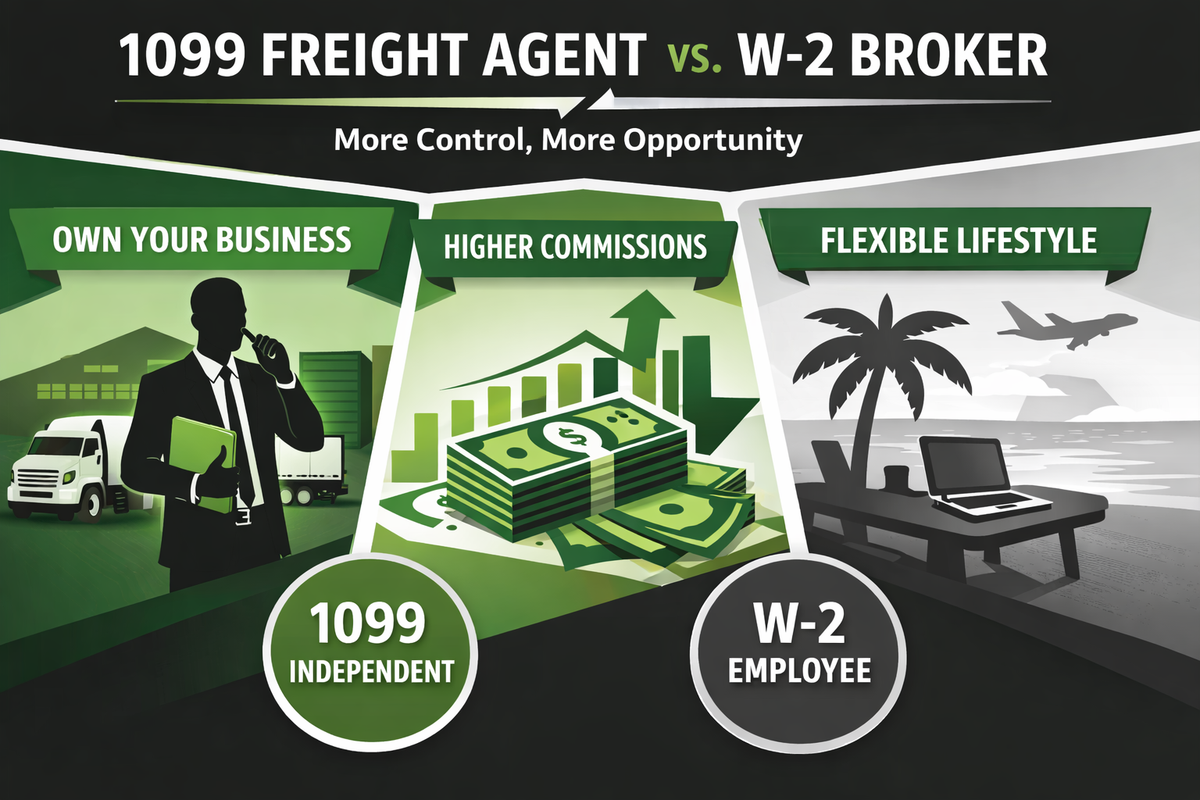
The freight brokerage industry continues to evolve, and with it, the way professionals build their careers.
As margins tighten and expectations increase, many brokers are reassessing whether a traditional W-2 role still aligns with their long-term goals. One question comes up consistently: is it better to remain a W-2 broker, or transition into a 1099 freight agent role?
While both paths exist in the industry, the 1099 freight agent model offers greater control, flexibility, and earning potential for experienced professionals ready to operate independently.
What Is the Difference Between a 1099 Freight Agent and a W-2 Broker?
At its core, the difference comes down to ownership and independence.
A W-2 broker is an employee of a brokerage. Compensation structure, customer ownership, operational processes, and performance expectations are largely defined by the company.
A 1099 freight agent operates as an independent contractor. Agents build and manage their own book of business while leveraging a brokerage’s infrastructure, including carrier networks, technology, compliance, and back-office support.
That structural distinction shapes everything that follows.
Why the 1099 Freight Agent Model Appeals to Experienced Brokers
The 1099 model is designed for professionals who want more control over how they work, how they grow, and how they are compensated.
Ownership of the Book of Business
One of the most significant advantages of being a 1099 freight agent is ownership.
1099 agents typically:
- Maintain control over customer relationships
- Own and manage their book of business
- Decide how accounts are serviced and expanded
In many W-2 roles, customer accounts ultimately belong to the brokerage. This can limit long-term leverage for brokers who invest years building trust and volume.
Higher Earning Potential
Compensation structures differ substantially between the two models.
W-2 brokers often receive:
- A base salary
- Lower commission percentages
- Tiered or capped incentives
1099 freight agents generally earn higher commission splits because compensation is directly tied to performance. While income may fluctuate early on, successful agents benefit from uncapped earning potential that reflects the value they create.
Flexibility in How You Operate
The 1099 model offers significantly more autonomy in day-to-day operations.
This often includes:
- Control over work schedules
- Freedom to pursue specific industries or freight types
- The ability to scale accounts at a self-directed pace
For brokers who no longer need constant oversight, this flexibility can improve productivity without sacrificing performance.
Fewer Corporate Constraints
W-2 broker roles often come with structured requirements such as:
- Mandatory office hours
- Prescribed sales processes
- Limited pricing flexibility
- Volume-driven quotas
1099 freight agents typically operate with fewer restrictions, allowing them to focus on service quality, specialized freight, and long-term customer relationships rather than transactional volume.
Operational Support Without Sacrificing Independence
A common concern when transitioning to a 1099 role is operational support.
The right brokerage partnership provides:
- Carrier onboarding and compliance
- Billing, invoicing, and collections
- Technology platforms and shipment visibility
- Insurance coverage and regulatory oversight
This allows agents to operate independently without the burden of building a brokerage from scratch.
Is the 1099 Freight Agent Model the Right Fit?
The 1099 model is not designed for every broker.
It is best suited for professionals who:
- Are self-directed and accountable
- Have experience managing freight independently
- Value long-term earning potential over short-term stability
- Want ownership of customer relationships and growth strategy
For newer brokers, a W-2 environment can provide structure and training. For experienced brokers, the 1099 model often represents the next logical step.
Final Perspective
The decision between a W-2 broker role and a 1099 freight agent model ultimately comes down to how much control, flexibility, and ownership you want in your career.
For brokers ready to operate independently while leveraging strong operational support, the 1099 freight agent path offers a scalable, performance-driven alternative — built on accountability, autonomy, and long-term opportunity.
Tags

About the Author
exodus logistix
Exodus Logistix provides freight and logistics solutions built on disciplined planning, clear coordination, and operational accountability. With experience supporting complex shipments across multiple industries, the team focuses on reducing disruption, improving reliability, and helping businesses move freight with confidence.